What Size Rug for a Living Room? The Measurements That Actually Work
Most living room rugs are too small. Here are the real measurements, placement rules and price ranges to get the size right the first time.
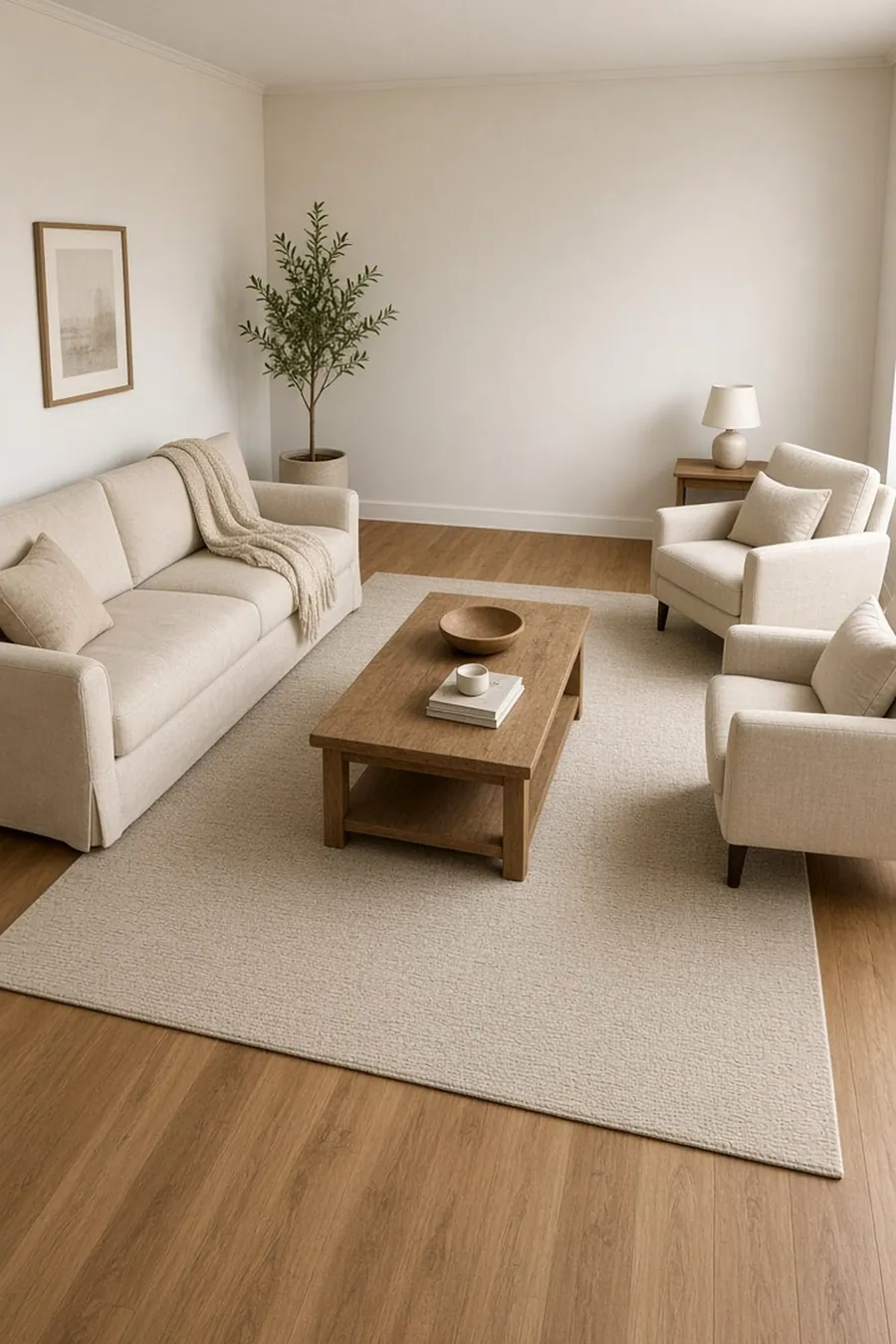
Buy the bigger rug. If you only remember one thing from this guide, make it that.
A rug that’s too small is the most common living room mistake we see, and it’s a frustrating one because you can’t fix it with a throw pillow. A 5x8 floating in the middle of a 12 x 15 room makes every piece of furniture look like it’s been pushed against the walls. The right size pulls the seating together into one group and makes the room look planned, even if half the furniture came from Facebook Marketplace.
Here are the numbers, so you can measure once and order with confidence.
Measure the seating area, not the whole room
Your rug is there to anchor the conversation area, so that’s what you measure: the sofa, the chairs and the coffee table, plus a little breathing room.
Then check it against the walls. In most living rooms you want 12 to 18 inches of bare floor between the rug and the walls. In a small room you can go down to about 8 inches. Any closer and it starts to look like carpet that was cut wrong.
Quick example: a 12 x 15 ft room, minus 18 inches on every side, gives you 9 x 12 ft. That’s your ceiling. If your furniture is grouped in only part of the room, size for that zone instead.
The three ways furniture can sit on a rug
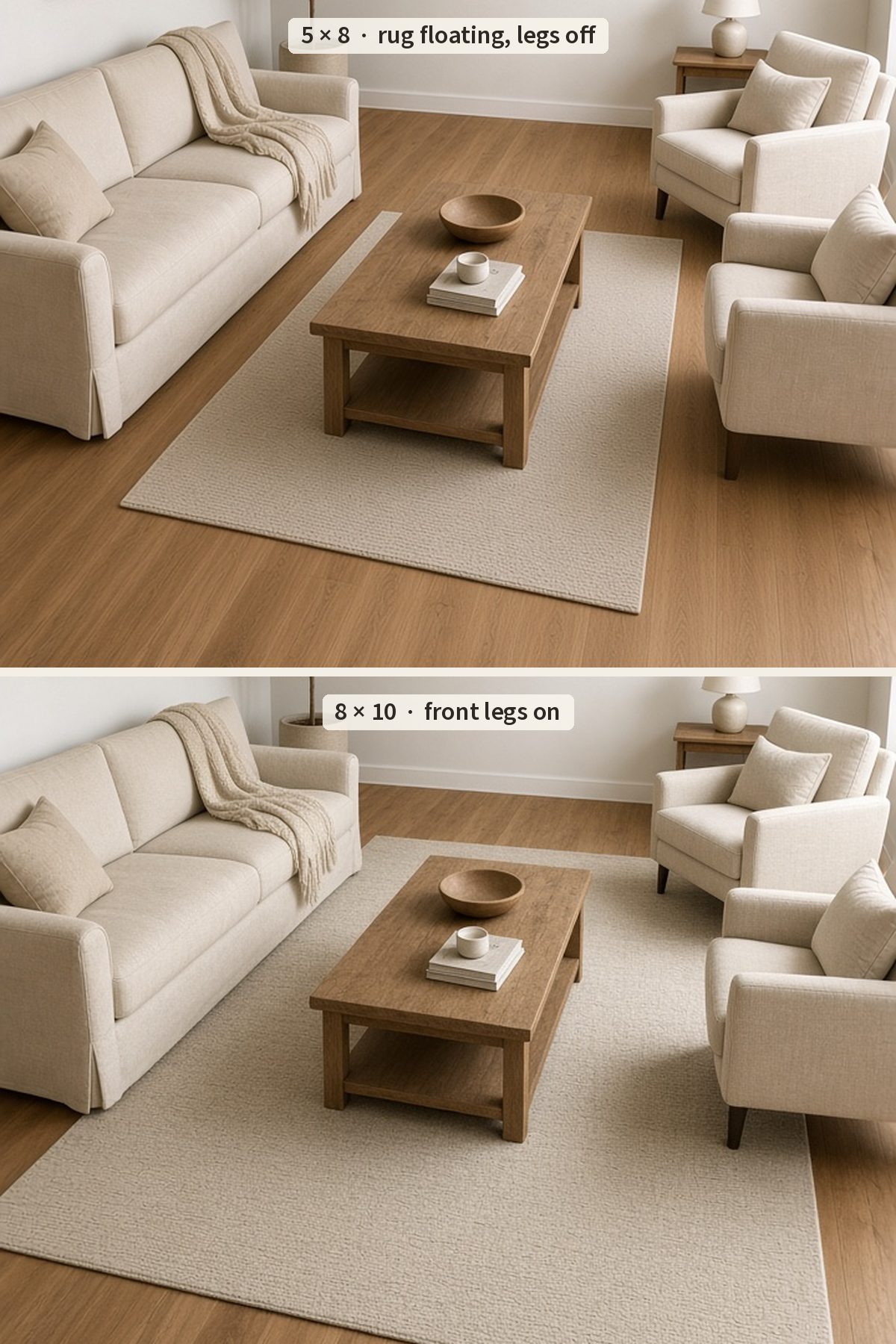
All legs on. Every piece of seating sits fully on the rug. It looks generous and very finished, but you need a big rug (9x12 or larger) and a big enough room. Best for open-plan spaces where the rug is doing the job of a wall.
Front legs on. The front legs of the sofa and chairs sit on the rug, the back legs sit on the floor. This is the one we’d recommend for most apartments and starter homes. It connects everything without needing a huge rug, and it’s forgiving if your room is an awkward shape. The front legs should be at least 6 inches onto the rug so they don’t teeter on the edge.
No legs on (floating). The rug sits in front of the sofa under the coffee table only. It can work in a genuinely tiny room or with a loveseat, but in an average living room it’s the “postage stamp” look. If you go this way, the rug should still be wider than the coffee table by a good margin and get close to the sofa, within 6 inches or so.
One more width rule: the rug should run at least 6 to 8 inches past each end of the sofa. A standard three-seat sofa is around 84 inches long, so it wants a rug at least 96 to 100 inches wide on that side. That’s why an 8x10 placed with the 10-foot side along the sofa works for so many rooms.
Standard rug sizes and where they fit
| Rug size | Usually works for |
|---|---|
| 5x8 | Rooms under about 10 x 12, a loveseat setup, or a reading corner |
| 6x9 | Small apartment living rooms where 8x10 crowds the walls |
| 8x10 | The default for most living rooms, roughly 11 x 13 to 12 x 15 |
| 9x12 | Larger rooms and open plans, or when you want all legs on |
| 10x14 | Big rooms, or a sectional with a deep chaise |
The 6x9 is underrated. It costs noticeably less than an 8x10, and in a 10 x 12 living room it often fits better. It’s worth checking before you settle for a 5x8.
Tape it out before you buy
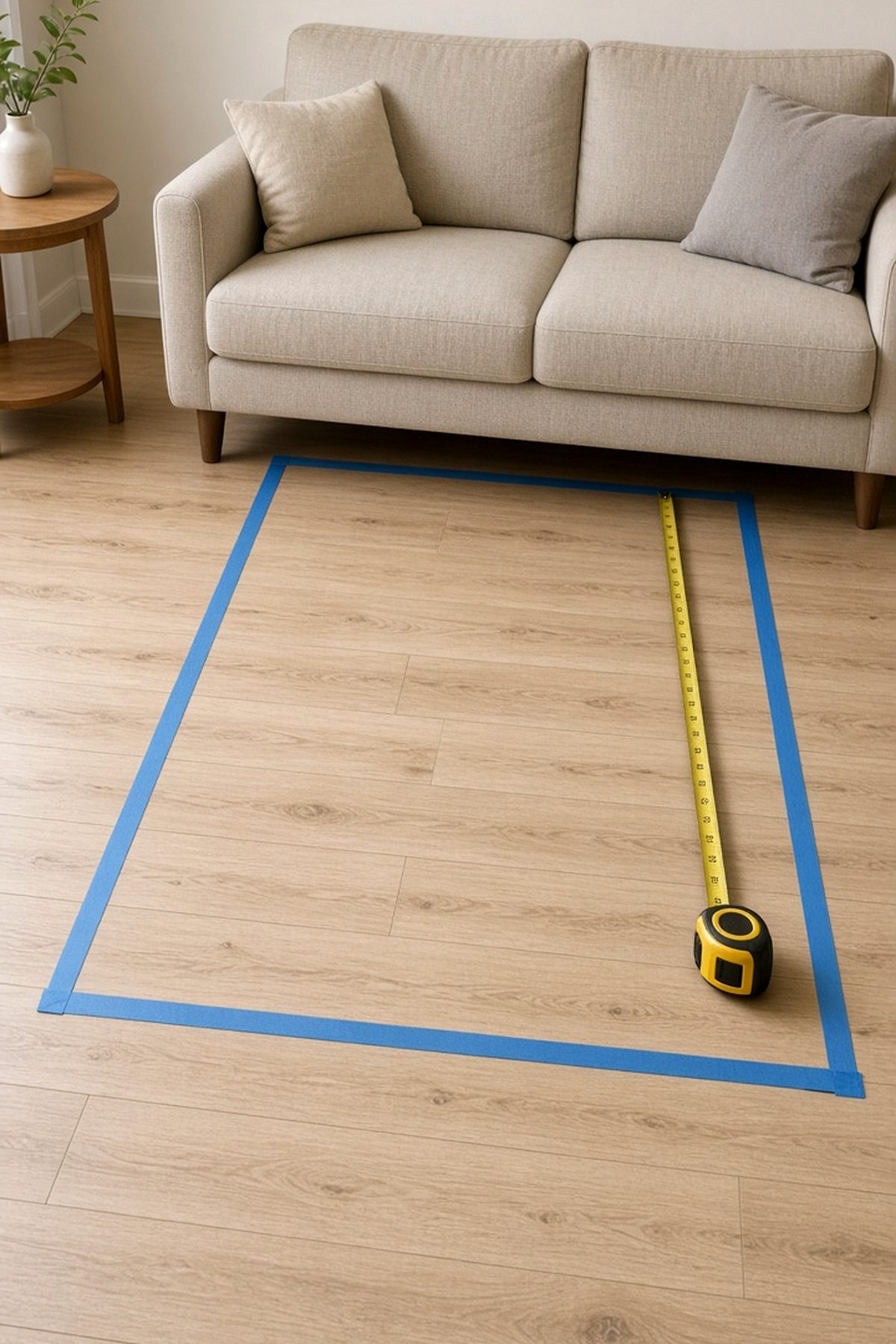
This takes ten minutes and saves the hassle of a rug return, which is miserable with anything bigger than a 5x8. Use painter’s tape to mark the rug’s outline on the floor. Live with it for a day or two. Walk around it, sit on the sofa, open the doors.
You’ll notice things a floor plan won’t tell you. A door that sweeps over the corner of the rug (it will snag every time). A heating vent half covered. A walkway where the rug edge sits right where you step, which is how people trip.
Sectionals and open-plan rooms
With an L-shaped sectional, get the front legs of both sides onto the rug. The rug’s edges should run parallel to the sectional’s backs, and the chaise can sit fully on or with its front legs on. Sectionals are deep, so this is where people end up needing a 9x12 when they budgeted for an 8x10. Measure the outside dimensions of the sectional before you shop.
In an open plan, the rug is effectively a room divider. If the back of your sofa faces the dining area, the rug should end close to the sofa back, or run a few inches past it. A rug that stops short in front of the sofa leaves the seating area looking unfinished from the dining side.
Materials and what they cost
Prices vary a lot by brand and season, so treat these as rough ranges for an 8x10.
- Polypropylene (synthetic): roughly $120 to $350. Stain-resistant, easy for pets and kids, and usually fine for renters on a budget. It can flatten in high-traffic paths and some feel a bit plasticky underfoot.
- Jute and sisal: roughly $200 to $500. Natural texture and great for layering. The downside is that they’re scratchy for floor-sitting, and water can leave marks, so they’re not ideal near an entry door or under a dog’s water bowl.
- Wool (tufted or flatweave): roughly $400 to $1,200. Wool is our favorite if you can stretch for it. It’s naturally resilient, hides dirt well and feels good on bare feet. Expect shedding for the first few months on tufted wool; that’s normal.
- Machine-washable rugs: roughly $250 to $650 for an 8x10, depending on the brand and whether it comes with a separate pad. Good for pets and young kids. They’re thinner than most rugs, so they read a bit flat.
If you’re torn between a cheap rug in the right size and a nicer rug in the wrong size, buy the right size. Size affects the whole room. Pile quality mostly affects your feet.
Don’t skip the rug pad
A pad stops sliding, protects your floor and makes a thin rug feel twice as expensive. Choose one about 1 inch shorter than the rug on every side, so an 8x10 rug gets roughly a 7‘10” x 9‘10” pad. Most pads can be trimmed with sharp scissors.
For hard floors, a felt-and-natural-rubber pad is the usual pick. It grips and cushions. Avoid cheap PVC grid pads on finished hardwood or vinyl plank; some can react with floor finishes over time, so check what your flooring manufacturer says. If you rent, that’s a deposit issue as well as an aesthetic one.
When the right size is out of budget
Layer. A large, inexpensive jute or flatweave rug in the correct size (8x10 or 9x12) becomes the base, and a smaller patterned or vintage-style rug goes on top, usually a 5x8 or 6x9 centered under the coffee table. You get the proportion from the big rug and the color from the small one, often for less than a single large patterned rug. Keep the top rug thin so the edge doesn’t become a trip hazard.
Layering also works if you already own a 5x8 you love and don’t want to replace it.
Common mistakes, quickly
- Choosing the size by price rather than by measuring.
- Centering the rug in the room instead of under the seating group.
- Letting one leg of a chair sit half on the edge, so it rocks.
- Forgetting door swing and floor vents.
- Buying a rug pad that’s the same size as the rug, so the pad edge shows.
Once the rug is sorted, lighting is usually the next thing that makes a living room feel finished. We broke that down in our guide to living room lighting. Working with a studio or one-room layout? Our studio apartment layout ideas cover how to use rugs to split one room into zones. And for more general ideas, see our living room decorating ideas and these easy ways to make your house look more expensive, where getting the rug size right is near the top of the list.